


 By
By The National Basketball Association has been one of the most influential sports leagues in the world for decades. Alongside the National Football League and Major League Baseball, the NBA helped define the modern era of professional sports in North America.
Over the years, each generation of basketball fans has experienced its own era of greatness. The 2000s gave us superstars like Kobe Bryant and Tim Duncan, while the 2010s were shaped by players such as LeBron James and Stephen Curry.
However, when fans debate the greatest era in NBA history, the 1990s NBA is often the decade that dominates the conversation. For many basketball enthusiasts, the 1990s represent the golden age of the sport—an era defined by intense rivalries, physical gameplay, iconic personalities, and unforgettable championship battles.
But was the 1990s truly the best decade in NBA history? And if so, what made it so special compared to modern basketball?
In this article, we explore the key reasons why the 1990s NBA continues to be remembered as one of the most exciting and influential eras in basketball history.
The Era of Michael Jordan and the Chicago Bulls
No discussion about the 1990s NBA can begin without mentioning Michael Jordan and the legendary Chicago Bulls.
Jordan was not only the most dominant player of the decade but arguably the most influential athlete in basketball history. During the 1990s, he led the Bulls to six NBA championships, winning every Finals appearance they reached during the decade.
The Bulls’ championship runs occurred in two dominant periods:
-
1991–1993
-
1996–1998
These back-to-back “three-peats” turned the Chicago Bulls into one of the most iconic teams in sports history.
Jordan’s competitive drive, scoring ability, and clutch performances made him a global superstar. He consistently delivered unforgettable moments on the biggest stage, including game-winning shots and historic playoff performances.
More importantly, Jordan helped transform the NBA into a global brand. His popularity expanded the league’s reach far beyond the United States, inspiring millions of fans worldwide.
Because of his dominance and charisma, the 1990s NBA became closely associated with the legacy of Michael Jordan.
Intense Rivalries Defined the Decade
Another key reason the 1990s NBA was so memorable was the presence of intense rivalries between teams.
One of the most famous rivalries of the early 1990s involved the Chicago Bulls and the Detroit Pistons, known for their aggressive playing style and defensive toughness.
Nicknamed the “Bad Boy Pistons,” Detroit had dominated the late 1980s and early 1990s, winning back-to-back championships. Their physical approach often targeted Michael Jordan, leading to heated playoff battles between the two teams.
Eventually, the Bulls overcame the Pistons, marking the beginning of Chicago’s dominance.
Another unforgettable rivalry of the decade involved the New York Knicks and the Indiana Pacers. These teams frequently clashed in the playoffs, producing dramatic games and intense fan reactions.
One player who became infamous in New York was Reggie Miller, whose clutch shooting performances often silenced the crowd at Madison Square Garden.
The Bulls themselves faced strong competition in the NBA Finals from teams such as:
-
Phoenix Suns
-
Seattle SuperSonics
-
Utah Jazz
Although these teams challenged Chicago, the Bulls ultimately won all six Finals appearances during the decade.
These rivalries created unforgettable playoff series that fans still remember today.
Larger-Than-Life Personalities
The 1990s NBA was filled with charismatic figures both on and off the court.
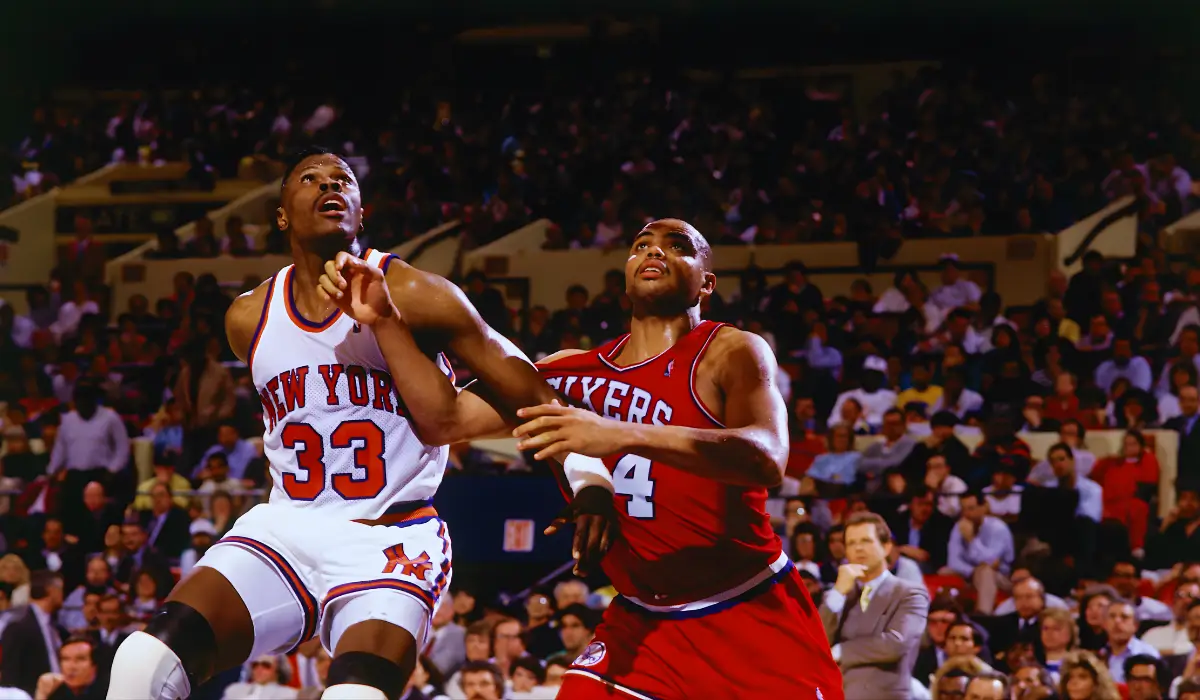
Players like Shaquille O’Neal, Charles Barkley, and Dennis Rodman brought unique personalities and styles that made the league incredibly entertaining.
Rodman, in particular, became famous not only for his defensive dominance and rebounding ability but also for his eccentric personality and colorful lifestyle.
Meanwhile, Shaquille O’Neal emerged as one of the most physically dominant centers the NBA had ever seen.
Coaches also played an important role in shaping the era. Legendary figures such as Phil Jackson and Pat Riley helped define the strategies and leadership styles that guided many successful teams.
At the league level, commissioner David Stern played a major role in expanding the NBA’s global popularity.
These personalities gave the 1990s NBA a distinctive character that many fans believe is missing from the modern game.
A More Physical Style of Basketball
One of the biggest differences between the 1990s NBA and modern basketball was the physical nature of the game.
During the 1990s, defensive players were allowed to use techniques such as hand-checking, which allowed defenders to apply more pressure on offensive players.
As a result, scoring was often more difficult, and games were typically lower scoring than they are today.
Players had to fight through tough defensive schemes and physical contact in order to score. This style of play created a gritty and intense atmosphere that many fans found exciting.
Stars such as Hakeem Olajuwon were known for their ability to dominate both offensively and defensively. Unlike some modern players who specialize in scoring, many 1990s stars were expected to contribute on both ends of the court.
This two-way style of play added another level of competitiveness to the game.
The Importance of Individual Skill
The offensive strategies of the 1990s NBA were often centered around isolation basketball, where star players were given space to create scoring opportunities one-on-one.
This approach placed a heavy emphasis on individual skill and creativity. Players had to rely on their footwork, ball handling, and shooting ability to beat defenders.
Many of the era’s most famous moments came from isolation plays, including Jordan’s iconic game-winning shots.
Because of this style, fans were able to witness more direct battles between elite players, which added to the drama and excitement of games.
Memorable Championship Contenders
Although the Chicago Bulls dominated the decade, the 1990s NBA still featured many talented teams.
The Houston Rockets, led by Hakeem Olajuwon, won back-to-back championships in 1994 and 1995 during Michael Jordan’s brief retirement.
Meanwhile, the Orlando Magic, featuring Shaquille O’Neal and Penny Hardaway, emerged as one of the most exciting young teams in the league.
Even teams that never won a championship—such as the New York Knicks and Indiana Pacers—remained strong contenders throughout the decade.
This competitive balance ensured that every season brought new storylines and dramatic playoff battles.
A Different Fan Experience
Another factor that made the 1990s NBA feel unique was the overall fan experience.
During that era, basketball was not as easily accessible as it is today. Fans did not have social media, streaming services, or constant online coverage.
Instead, many people relied on television broadcasts, sports magazines, and newspaper reports to follow the league.
One of the most popular programs was NBA on NBC, which delivered iconic broadcasts of NBA games throughout the decade.
Because access to games and information was more limited, every televised matchup felt like a special event.
This sense of scarcity made the games feel more significant and memorable.
Lower Scoring but Higher Stakes
Statistically, NBA teams in the 1990s averaged fewer points per game than modern teams. Many games ended with scores below 100 points.
However, this lower scoring often made each basket more meaningful. When points were harder to come by, every possession carried greater importance.
Today, teams frequently score more than 120 points in a game, largely due to increased three-point shooting and faster pace.
While modern basketball offers high-scoring entertainment, some fans feel that the 1990s style created more suspense and intensity.
Could the NBA Return to a 1990s Style?
Basketball constantly evolves, and the modern NBA has developed its own identity. The league today emphasizes spacing, three-point shooting, and fast-paced offensive systems.
Teams like the Golden State Warriors, led by Stephen Curry, helped popularize the three-point revolution during the 2010s.
However, basketball strategies often evolve in cycles. Some modern teams are already exploring alternative approaches, focusing more on defense and mid-range scoring.
For example, teams like the Oklahoma City Thunder have shown that defensive intensity and versatile scoring can still be effective in the modern game.
While the NBA may never look exactly like it did in the 1990s, elements of that era’s style could eventually return.
Conclusion
The 1990s NBA remains one of the most beloved eras in basketball history.
From the dominance of Michael Jordan and the Chicago Bulls to the intense rivalries, physical gameplay, and unforgettable personalities, the decade produced countless memorable moments.
While modern basketball offers incredible talent and global reach, many fans still view the 1990s as a unique period when competition, intensity, and storytelling combined to create a truly special era.
Whether it was the fierce rivalries, the legendary players, or the dramatic playoff battles, the 1990s NBA left a lasting impact on the sport.
Even today, the influence of that decade continues to shape the way basketball is played, watched, and remembered around the world.