



 By
By Artificial intelligence is no longer just a technological breakthrough—it is a geopolitical force. In 2026, the debate over who controls Global AI Governance AI governance has become one of the most consequential power struggles in the world. From Washington to Beijing, governments are racing not only to build the most advanced AI systems, but to shape the global rules that will govern their development, deployment, and ethical boundaries.
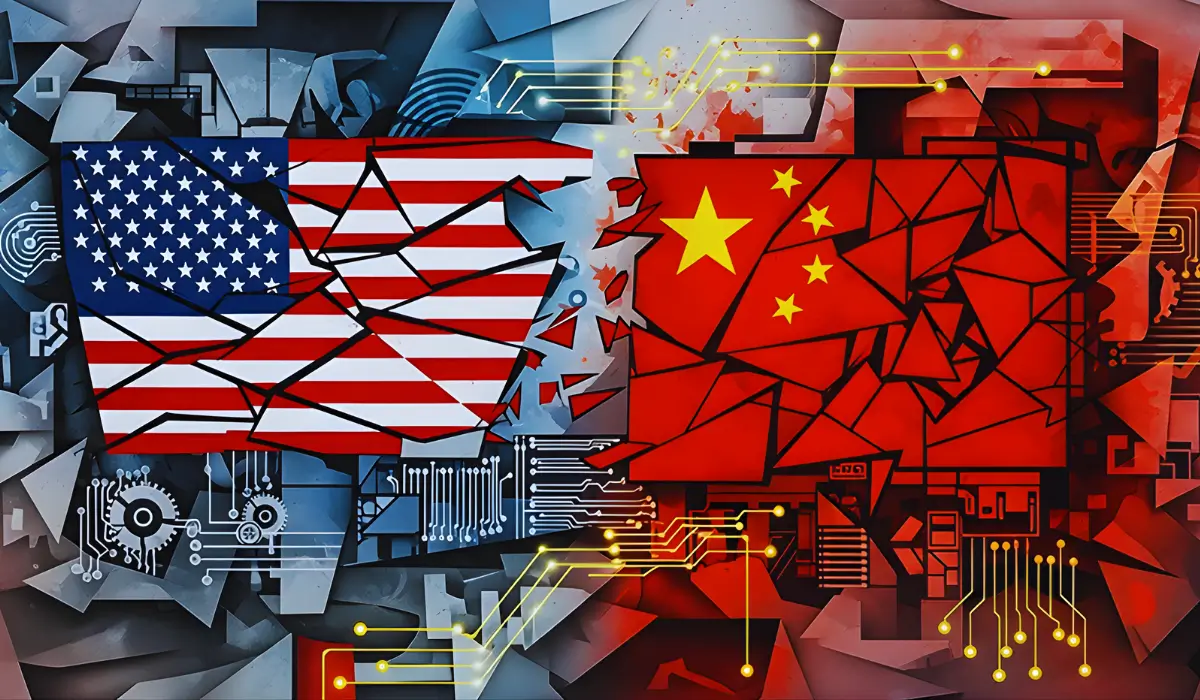
What was once a policy discussion has evolved into a defining confrontation between two competing visions of digital power: a deregulation-first American strategy and a centralized, treaty-driven Chinese approach. At stake is more than innovation—it is influence over the political, economic, and moral architecture of the AI-powered future.
Global AI Governance Becomes a Global Flashpoint
The question of AI governance has rapidly moved from academic circles into diplomatic summits and executive offices. As artificial intelligence begins to shape elections, financial markets, cybersecurity, and military strategy, policymakers recognize that the rules written today will determine global power dynamics tomorrow.
In early 2025, following his return to office, Donald Trump signed Executive Order 14179, dismantling several Biden-era AI safety frameworks and introducing what his administration branded the “AI Action Plan.” The initiative emphasized deregulation, private-sector leadership, and aggressive innovation.
Meanwhile, China responded by intensifying calls for a binding global framework under the auspices of the United Nations, proposing an international treaty to govern AI ethics, data sovereignty, and military applications.
The divergence could not be clearer.
The AI Cold War Heats Up
Observers increasingly describe the current rivalry as an “AI Cold War.” Unlike the nuclear arms race of the 20th century, this confrontation is not centered on destructive weapons alone—it revolves around algorithms, data dominance, and digital standards.
At the 2025 AI Summit in Washington, Trump framed the issue as a matter of economic survival and national pride:
“We’re not going to let red tape slow down American genius. We will lead, not follow.”
The AI Action Plan commits billions in federal support to accelerate research, incentivize domestic AI startups, and expand semiconductor manufacturing. The administration’s position is straightforward: innovation thrives best with minimal regulatory constraints.
Across the Pacific, Beijing has articulated a very different philosophy. Chinese officials argue that unregulated AI could destabilize societies, undermine sovereignty, and widen global inequality. Their proposal—introduced during a G20 side meeting—calls for the creation of a Global AI Ethics Council, with oversight authority and representation from emerging economies.
Two Competing Philosophies of AI Governance
1. The American Model: Innovation First
The U.S. approach under Trump centers on deregulation, private investment, and competitive acceleration. Key pillars include:
-
Reducing federal oversight of AI research and deployment
-
Tax incentives for AI startups
-
Expanding defense-related AI contracts
-
Blocking state-level AI restrictions that could slow development
The administration argues that overregulation would cede technological leadership to authoritarian competitors. Silicon Valley largely supports policies that prioritize speed and scale.
However, critics warn of unintended consequences. Without guardrails, AI systems could exacerbate misinformation, invade privacy, automate job displacement, and entrench bias. Scholars at institutions like Stanford University have raised concerns about algorithmic accountability and transparency.
Some experts describe the strategy as “high risk, high reward”—a gamble that innovation will outpace harm.
2. The Chinese Model: Centralized Control & Global Standards
China’s proposal reflects its broader governance philosophy: centralized oversight, data control, and long-term strategic planning.
Beijing’s framework emphasizes:
-
Binding international rules on AI deployment
-
Regulation of surveillance technologies
-
Restrictions on autonomous weapons
-
Algorithmic accountability mechanisms
-
Governance under UN leadership
Officials argue that global cooperation is the only safeguard against what they describe as “digital colonization” and destabilizing AI misuse.
Yet skepticism remains strong in Western capitals. Critics argue that China’s advocacy for global governance may simultaneously expand its influence in the Global South, where Chinese firms already dominate smart city infrastructure and surveillance systems.
As digital policy analyst Lydia Freeman noted:
“China isn’t just exporting hardware—it’s exporting governance models.”
The tension lies in whether Beijing’s framework prioritizes ethics—or geopolitical leverage.
Europe: The Third Path?
While Washington and Beijing dominate headlines, the European Union has quietly advanced its own regulatory blueprint through the AI Act.
The EU model focuses on:
-
Risk-based categorization of AI systems
-
Strict limits on biometric surveillance
-
Transparency requirements for high-risk applications
-
Heavy penalties for non-compliance
However, Europe faces structural limitations. Unlike the U.S. and China, it lacks unified military or technological dominance, making global enforcement of its standards difficult.
Still, some analysts believe the EU could emerge as a stabilizing force—bridging innovation and regulation without aligning fully with either superpower.
What Is Really at Stake?
The debate over AI governance is ultimately about power.
Whoever sets the standards for AI today will shape:
-
Global trade rules
-
Cybersecurity norms
-
Military strategy
-
Digital human rights
-
Cross-border data flows
Standards-setting determines market dominance. If American protocols become global norms, U.S. companies gain structural advantage. If China’s model prevails, its governance framework may shape the digital infrastructure of emerging economies for decades.
This is not just about algorithms—it is about sovereignty.
Risks of a Fragmented AI World
One possible outcome is a fragmented, multipolar AI order:
-
A U.S.-led innovation bloc
-
A China-led governance bloc
-
A regulated European sphere
-
Emerging economies forced to choose sides
Such fragmentation could lead to incompatible AI systems, regulatory conflicts, and technological decoupling. Cross-border data exchange could become politicized, complicating global trade and scientific collaboration.
Alternatively, a global treaty under the UN could unify standards—but achieving consensus among major powers remains highly uncertain.
The Role of the Global South
China’s outreach to developing nations adds another layer of complexity. Through infrastructure investments and technology exports, Beijing has expanded its digital footprint across Africa, Southeast Asia, and Latin America.
For many emerging economies, the decision is pragmatic rather than ideological. They seek affordable technology, reliable infrastructure, and economic growth.
If China pairs AI governance with infrastructure financing, it may gain diplomatic loyalty. If the U.S. offers innovation partnerships and private investment, it could secure influence through economic integration.
The battle for AI governance may ultimately be decided in capitals far from Washington and Beijing.
Ethical Concerns on Both Sides
Neither model is without criticism.
Concerns about the U.S. approach:
-
Lack of federal oversight
-
Potential privacy erosion
-
Algorithmic bias
-
Labor displacement without social protections
Concerns about the Chinese approach:
-
Surveillance expansion
-
Censorship risks
-
State dominance over data
-
Suppression of dissent
The global community faces a difficult choice: speed without sufficient guardrails, or structure that may compromise openness.
The Road Ahead
Later this year, the United Nations is expected to convene a special session on AI governance. Whether it produces a binding framework or merely diplomatic statements remains to be seen.
Several scenarios are possible:
-
A Global Treaty: Major powers compromise on baseline standards.
-
Regulatory Fragmentation: Competing blocs solidify separate rules.
-
Hybrid Framework: Regional agreements coexist with limited global coordination.
The outcome will shape innovation, civil liberties, and economic competition for decades.
Final Thoughts: Who Will the World Trust?
The AI governance debate is no longer theoretical—it is unfolding in real time. As artificial intelligence begins influencing elections, financial systems, military operations, and media ecosystems, governance choices carry profound implications.
In this escalating AI Cold War, the winner may not be the country that builds the fastest algorithm or the most powerful model. It will likely be the nation—or coalition—that earns global trust to manage AI responsibly.